With the modernization of the Lehtoniemi wastewater treatment plant, the Itkonniemi water treatment plant and several other renovation projects Insta has become a trusted maintenance and life cycle service partner for Kuopion Vesi. Kuopion Vesi has pursued a strategy based on one automation supplier and a unified automation system — an approach that harmonizes solutions, improves maintenance efficiency and enables a more streamlined stand by model with a smaller on call team.
Everything began with the renovation of Lehtoniemi, the most important wastewater treatment plant operated by Kuopion Vesi. The biological‑chemical activated sludge facility, originally completed in 1974, faced stricter environmental permit requirements, including year‑round ammonium‑nitrogen removal and phosphorus filtration. The largest renovation in the plant’s history was ahead, and Insta was selected to carry out the project covering electrification, instrumentation and automation. Notably, even though the plant remained fully operational throughout the renovation, purification results stayed fully compliant with the permit requirements.
Achieving year‑round nitrification, as required by the new environmental permit, demanded a higher sludge volume, which made it necessary to increase the capacity of the aeration tanks. The old tanks were renovated and an entirely new treatment line was built. Aeration compressors and air piping were renewed, and the aeration control method was redesigned through automation.
Due to tightened requirements for phosphorus removal, an additional post‑filtration unit based on sand filtration, proven highly effective, was integrated into the process. As a result, the new limit values were met effortlessly, and in many cases clearly exceeded.
During the renovation completed in summer 2015, the plant’s medium‑voltage switchgear and transformers were also renewed, further increasing the project’s technical complexity. The extensive automation upgrade, along with significant mechanical, electrical and automation work and a redesigned control room, brought the facility into a new technological era.
As part of the project, approximately 200 wastewater pumping stations in the Kuopio area were integrated into Lehtoniemi’s SIMATIC PCS 7‑based remote‑monitoring system, and with the addition of sites from surrounding municipalities, around one hundred more locations were included.
Siemens Business Line Director Jussi Salomaa contributed to defining the system requirements from Siemens’ side.
– Our solution partner Insta has strong process expertise, which also gives them valuable insight into defining the system. Our roles complement each other well. In the Lehtoniemi project, Insta delivered the turn‑key solution and defined the system, while we supported component selection and provided targeted training whenever needed, Salomaa summarizes.
Today, the Lehtoniemi plant treats the wastewater of more than one hundred thousand people. The facility is up to 80 percent energy self‑sufficient — dried sludge is digested, and the resulting biogas is converted into useful energy. The treatment process at the parallel precipitation plant proceeds through continuous, parallel steps: sand and solids are removed mechanically, organic matter and nitrogen are treated biologically, and phosphorus is removed chemically. Water quality is monitored through weekly sampling, and after all treatment stages, the water discharged into nearby Lake Kallavesi is cleaner than the lake water itself.
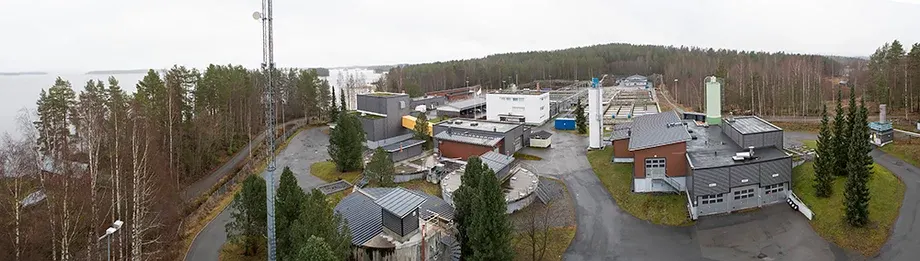
Collaboration with Kuopion Vesi began with the renovation of the Lehtoniemi wastewater treatment plant in 2012.
A Unified System Brings Maintenance Benefits and Streamlines Stand‑By Operations
When a partner was sought to modernize the Lehtoniemi automation system, it quickly became clear that the scope extended far beyond a single wastewater treatment plant. Behind Kuopion Vesi’s decision was a broader strategic objective: adopting one automation supplier and one unified automation system to harmonize solutions and achieve clear maintenance benefits. In the longer term, the strategy also aimed to streamline and consolidate stand‑by operations so they could be managed with a smaller team.
– The Lehtoniemi project set the direction for implementing this strategy. One automation supplier and one system is also the most sensible approach for the maintenance and life‑cycle management within our electrification, instrumentation and automation department, explains Automation Engineer Arto Hoffren.
– When the same spare parts fit everywhere and the remote devices are all based on Siemens technology delivered by Insta, it makes a significant difference in our daily work. We can carry out plant modifications and repairs remotely instead of having to drive up to a hundred kilometers.
During the Lehtoniemi project, the technical principle decisions were made for Kuopion Vesi’s entire automation and remote‑control system, as well as for its reporting and maintenance systems. At the same time, remote‑control and automation functions were partially implemented for water production sites, and the reporting and maintenance system included in the Insta Wahti® range of services was deployed at the Itkonniemi water treatment plant.
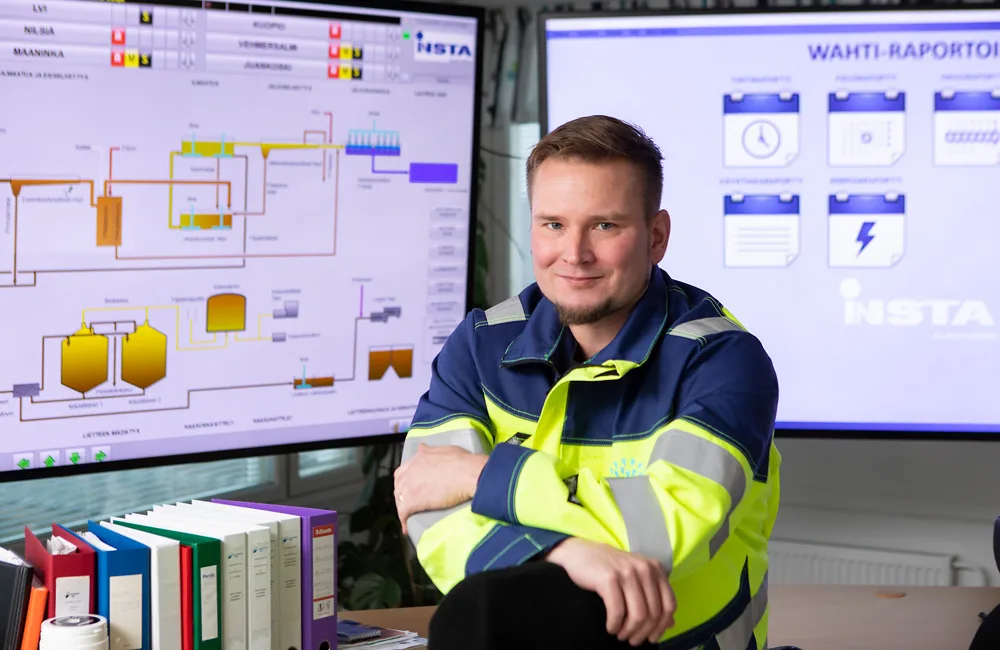
Automation Engineer Arto Hoffren from Kuopion Vesi at the Lehtoniemi wastewater treatment plant control room. In the background the process view of the treatment plant and the Insta Wahti® Reporting software.
More Network Kilometers and the Renovation of the Main Water Plant
Today, the automation system operated by Kuopion Vesi is one of the largest unified automation systems in Finland. It consists of two major plants, numerous smaller facilities and hundreds of remote‑monitored sites. The overall system has expanded especially through municipal mergers — in total, six municipalities with their treatment plants and water production facilities joined between 2012 and 2020.
The merger of Kuopio and Maaninka expanded the Kuopion Vesi network by more than 200 kilometers when the utility’s operating area was extended to cover the water services previously managed by the municipality of Maaninka at the beginning of 2015. Initial smaller projects were carried out first, and in 2016 it became time to modernize the automation systems of both water production and wastewater pumping. Before this, the renovation of the Melalahti wastewater treatment plant had been completed, with Insta serving as the main contractor — an uncommon role for an automation provider in water infrastructure projects, and one that strengthened Insta’s position as a trusted partner.
At the end of 2017, renovation began at the Itkonniemi water treatment plant, the main facility supplying drinking water to the central urban area of Kuopio and several water cooperatives. Commissioned in 1913, the plant was now facing the most extensive modernization since 1988. The goal was to secure uninterrupted water production far into the future. The project included renewing the automation system and all related process, mechanical, electrical and instrumentation equipment. The plant’s HVAC systems, office and laboratory areas, and control room were also modernized, and key water production sites across the urban area were upgraded in terms of automation, electrical installation and instrumentation. As a result, both wastewater and clean‑water facilities were integrated into a unified SIMATIC PCS 7 automation system.
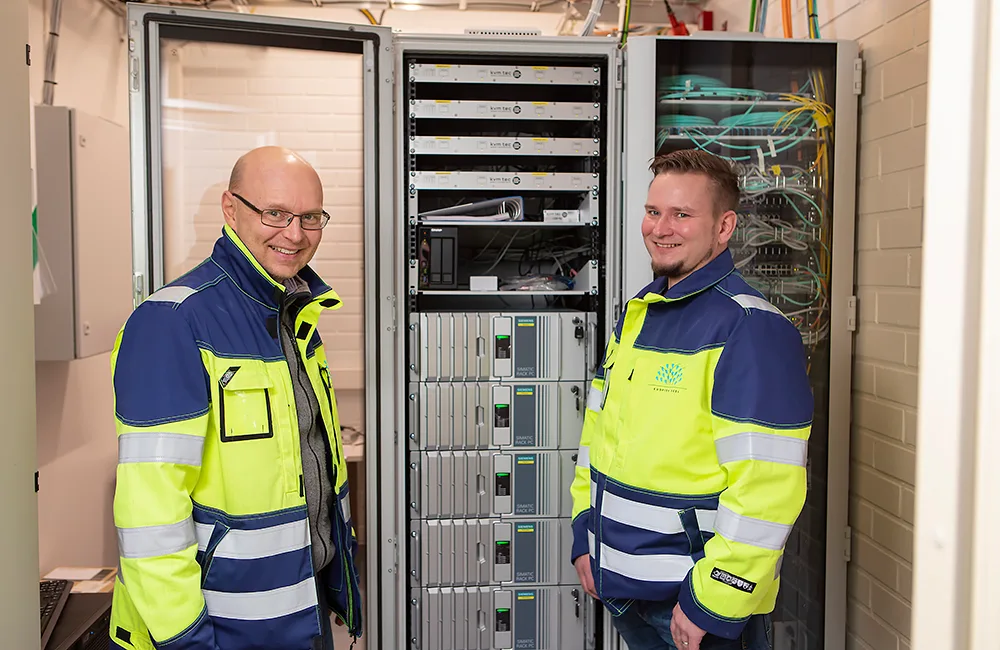
Markus Happonen and Arto Hoffren explain that having one automation supplier and one unified automation system is the most logical approach for the electrification, instrumentation and automation department.
The criticality of the Itkonniemi water treatment plant was taken into account from the very beginning of the design phase. Integrated safety technology and the ability to duplicate all system components ensured that the PCS 7 system could reliably control demanding and safety‑critical water‑production processes. Siemens Business Line Director Jussi Salomaa describes the operating principle of the integrated safety automation, noting that eliminating separate safety components or software also provides maintenance benefits over the system’s life cycle.
The required level of redundancy is defined according to customer needs. At the Itkonniemi plant, redundancy was implemented as extensively as possible to ensure system reliability. Redundant process stations were distributed throughout the building, and their communication paths were physically separated. As a result, even a fire in one section would not incapacitate the plant — process control would continue under the automation system.
Because the facility is the only plant supplying drinking water to the Kuopio region, it had to remain operational throughout the entire renovation, just like the Lehtoniemi wastewater treatment plant. This added complexity to commissioning, as both the old and new control systems had to run simultaneously during the transition.
– The most important factors in modernizing the automation system of a fully operating water‑treatment plant, and in ensuring a successful commissioning, are the correct sequencing of work phases and close planning together with the Kuopion Vesi team. Before starting the commissioning, it’s essential to assess how upcoming changes will affect interconnected subprocesses, so that all parts of the control system function without production interruptions. Extensive temporary arrangements were required to ensure error‑free operation of both systems, enabling a smooth transition without significant disruptions, explains Jari Niemi, Project Manager at Insta Automation for the Itkonniemi project.
In early summer 2019, a decision was made to incorporate Kuopion Vesi Liikelaitos and the Siilinjärvi municipal water utility into Kuopion Vesi Oy, jointly owned by the municipalities. Before the incorporation, Insta had carried out the electrification, instrumentation and automation project for the Jynkänniemi wastewater treatment plant in Siilinjärvi, using the same Siemens technology as in Kuopio. This created a solid foundation for integrating Siilinjärvi’s water‑supply operations into the unified automation system in 2021–2022. With the modernization of the automation systems in Juankoski and Siilinjärvi, the system will expand by another one hundred remote‑monitored facilities.
Ensuring Operational Reliability Through Long‑Term Partnership
Since the modernization of the Itkonniemi water treatment plant, Insta has served as a long‑term partner, ensuring the facility’s operational reliability through maintenance and life‑cycle support. Together, Insta and Kuopion Vesi have built the foundation for the remote operation of all clean‑water sites, integrating booster stations, water towers and various measurement stations into the unified system.
Markus Happonen, who leads electrical work and operations at Kuopion Vesi and the electrification, instrumentation and automation team, explains that a compact team of fewer than ten people is responsible for water production, wastewater operations and the distribution network. Close collaboration with a trusted partner is crucial to carrying out all required maintenance, repair and investigative work efficiently.
Automation Engineer Arto Hoffren describes Insta’s role as significant. Several projects are ongoing — some carried out internally and others executed together with Insta. The smooth collaboration has also been strengthened by Insta’s local offices, including the more recently established Kuopio site and the long‑standing Varkaus office.
– We receive support quickly and can advance projects on tight schedules. Even small projects are important to us because they help us develop our processes. The greatest benefit is having rapid access to full turn‑key support when needed and being able to move sites forward with reliable performance, Hoffren summarizes.
– In addition to the technical solution models, cost‑effectiveness is essential. Over the years, we have streamlined our ways of working — eliminating unnecessary intermediaries and hours. When we can get straight to the point, we save not only costs but, above all, time, Happonen adds.
– We’ve carried out a wide range of development work — visiting regional facilities, finding solutions to new challenges and continuously adapting where needed, Hoffren concludes
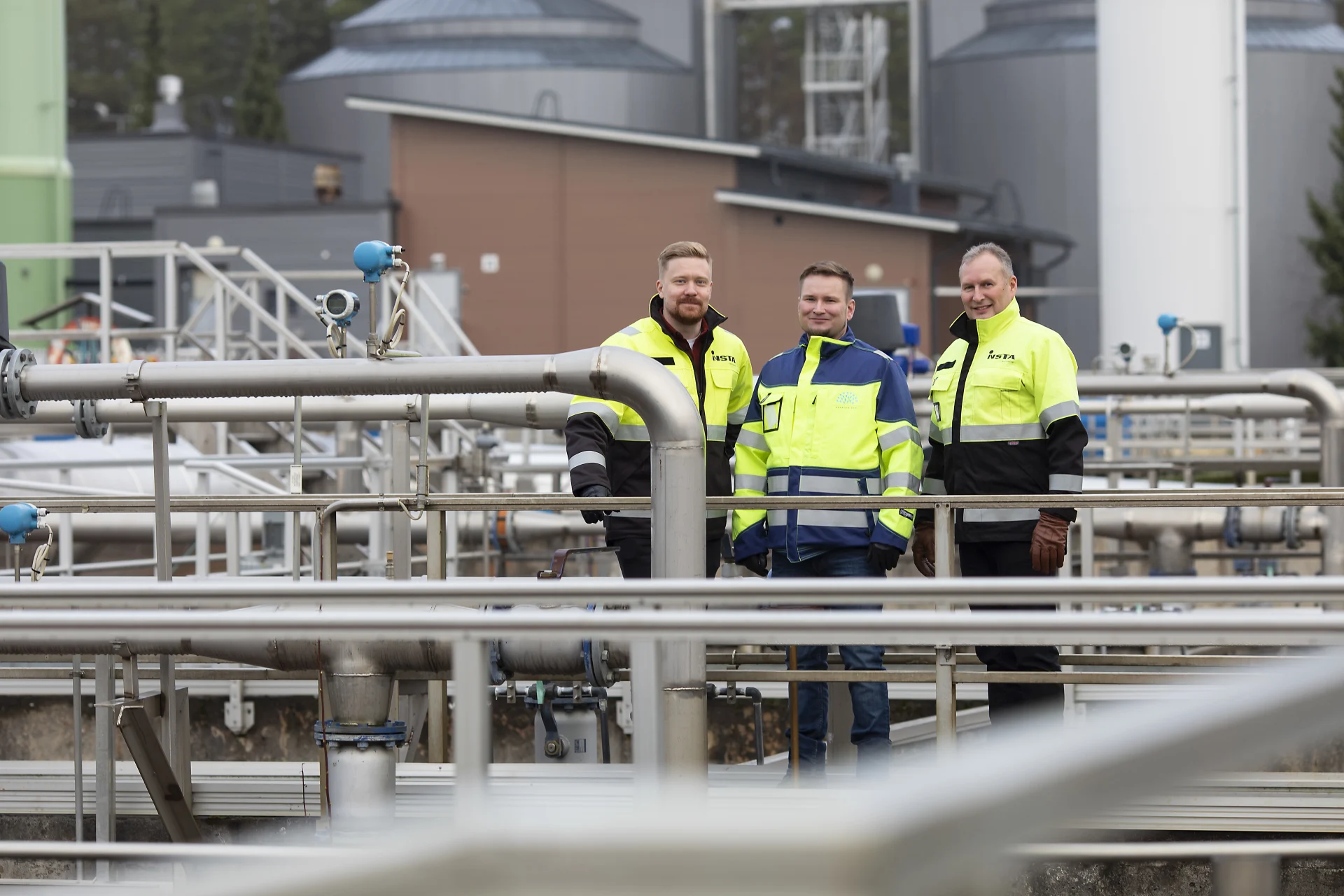
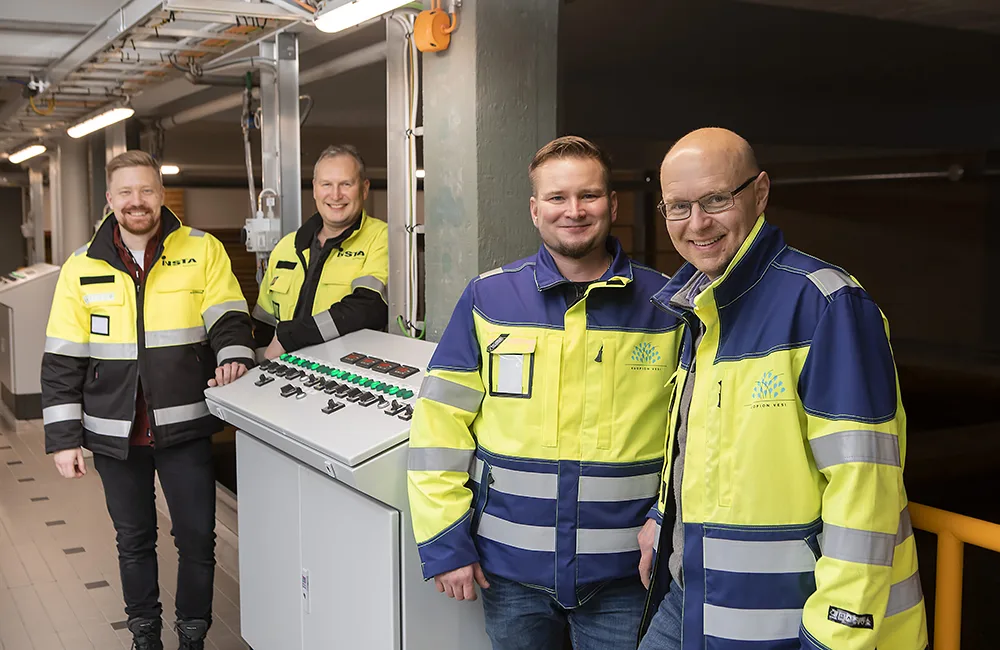
At the Lehtoniemi wastewater treatment plant’s aeration tanks: Jari Niemi, Arto Hoffren and Kimmo Suonperä. The collaboration has evolved into a close and trusted maintenance and life‑cycle partnership.
Explore our Water Supply solutions:
Water SupplyInterested in our turn‑key deliveries of automation, electrification, instrumentation, and digitalization solutions?
Turnkey deliveriesLearn more about our life‑cycle services:
Automation and electrification lifecycle services