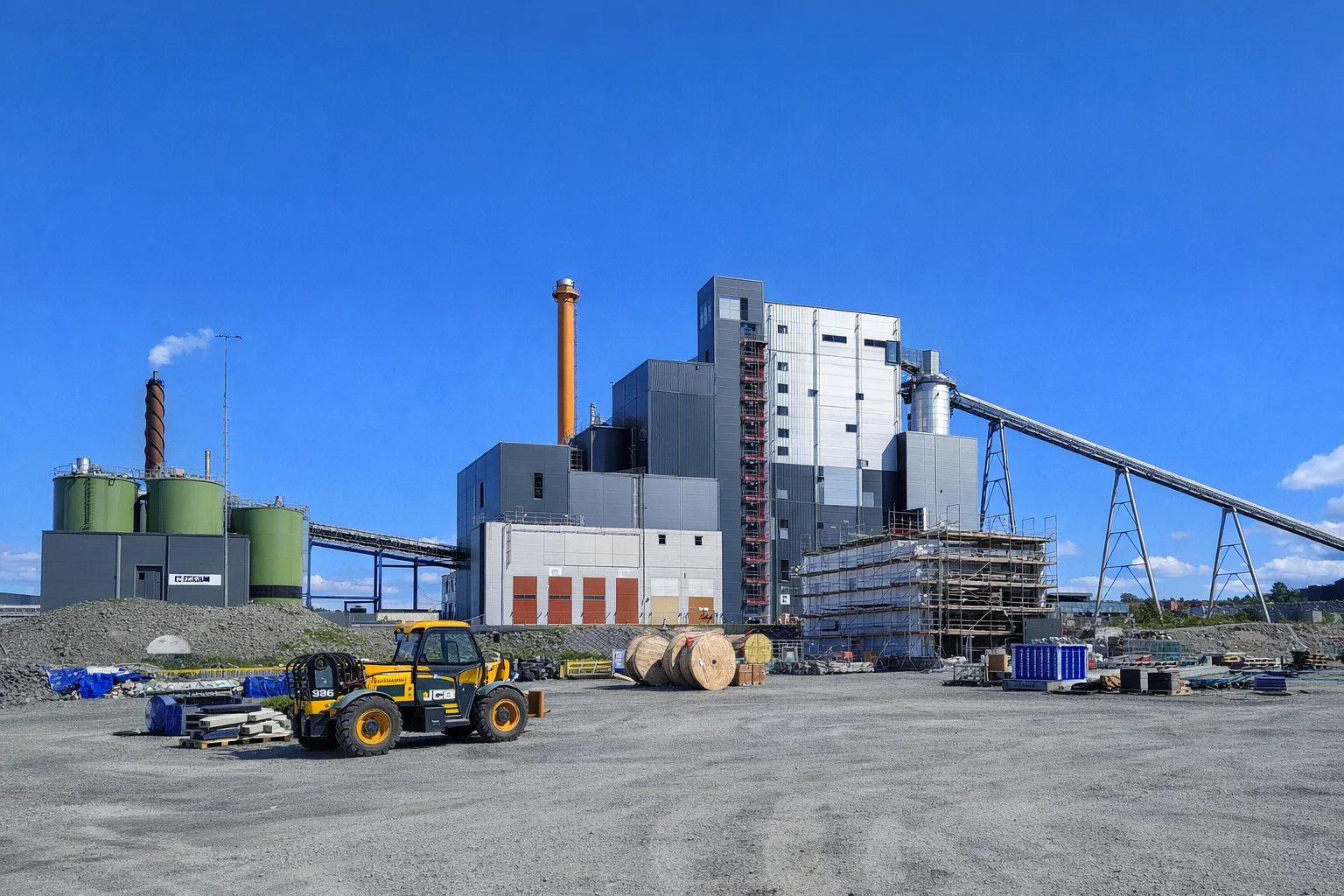
Jämtkraft built the new power plant in Lugnvik to replace older heating boilers and to secure the long-term supply of renewable district heating for the growing city of Östersund. The project also increases renewable electricity production, as approximately one third of the plant’s output is electricity and two thirds district heating.
At the heart of the plant is a 77 MWt bubbling fluidized bed (BFB) boiler supplied by Sumitomo SHI FW, capable of utilizing a wide range of biofuels, including forest industry side streams, forest chips, and other wood-based biomass.
Sumitomo SHI FW’s extensive EPC delivery included the boiler with auxiliaries, a flue gas condensing system, and a flue gas cleaning system. The delivery also covered electrification, instrumentation, and the distributed control system (DCS), as well as the boiler building.
Insta’s scope included the plant’s DCS/SIS system (Siemens-based Simatic PCS 7), which controls and monitors plant operations and ensures safety in all situations.
Third joint project – competitiveness and proven collaboration behind the selection
According to Jari Voutilainen, EIC-area Project Manager at Sumitomo SHI FW, Insta was selected based on competitive pricing and positive previous experiences:
"The new Lugnvik power plant was the third project carried out together by Insta and Sumitomo. The previous two projects were delivered for Seinäjoen Energia: the Hanneksenrinne heating plant, where Insta provided automation as well as electrical and instrumentation installations, and the Kymijärvi III bio power plant of Lahti Energia, where Insta’s role focused on instrumentation installations."
Challenging global situation required anticipation
The automation system project at Jämtkraft was an international, multi-supplier project where smooth collaboration and flexible responsiveness played a key role. The project progressed under demanding conditions: its early phase coincided with the COVID-19 pandemic, which impacted collaboration, travel, and practical execution. As the pandemic situation began to ease, the operating conditions shifted again due to the war in Ukraine, affecting material availability, supply chains, and costs. Under these circumstances, procurement and scheduling required more anticipation and flexibility than usual.
Voutilainen notes that Insta’s proactive procurement approach ensured the timely availability of equipment on site:
"The automation system was purchased a year earlier than in a typical project schedule – this ensured that, for example, I/O cards were available on site in time."
Proactive actions also resulted in cost savings, as prices increased significantly during the project.
Experience and expertise reflected in the outcome
The project involved numerous changes and additions, to which Voutilainen says Insta responded quickly and constructively.
"Insta’s project personnel have an excellent attitude. Changes and challenges are addressed constructively and resolved", Voutilainen summarizes.
He adds that project schedules were at times extremely tight, requiring fast responses and flexibility from all parties. Staff turnover at the site created additional challenges, as key personnel changed and information flow and responsibilities were not always fully seamless. According to Voutilainen, however, Insta’s team succeeded in maintaining control of the overall scope and ensuring steady progress.
The plant was commissioned in spring 2025. In the lessons learned feedback, Insta received particular praise for decision-making, collaboration, lifecycle thinking, and change management.
"We have come a long way in our collaboration – in this project, it already worked excellently in my opinion", Voutilainen comments.
"I have been working in this field for 40 years across several continents. Insta’s automation deliveries, electrical installations, and instrumentation installations stand up to global comparison and rank among the very best."