Insta has developed an intuitive analysis tool for Sandvik’s Mining and Rock Solutions business area. The tool models the operation of electric and diesel-powered mining equipment and enables users to compare different scenarios. It supports planning and decision-making while facilitating collaboration between sales, product development, and customers.
Sandvik Group is a global high-tech engineering group that provides equipment, tools, services, and technical solutions for the mining, manufacturing, and infrastructure industries. Many of Sandvik’s mining customers are exploring the electrification of their equipment and setting targets for reducing CO₂ emissions. However, replacing diesel-powered machines with electric alternatives takes time, particularly in demanding operating environments.
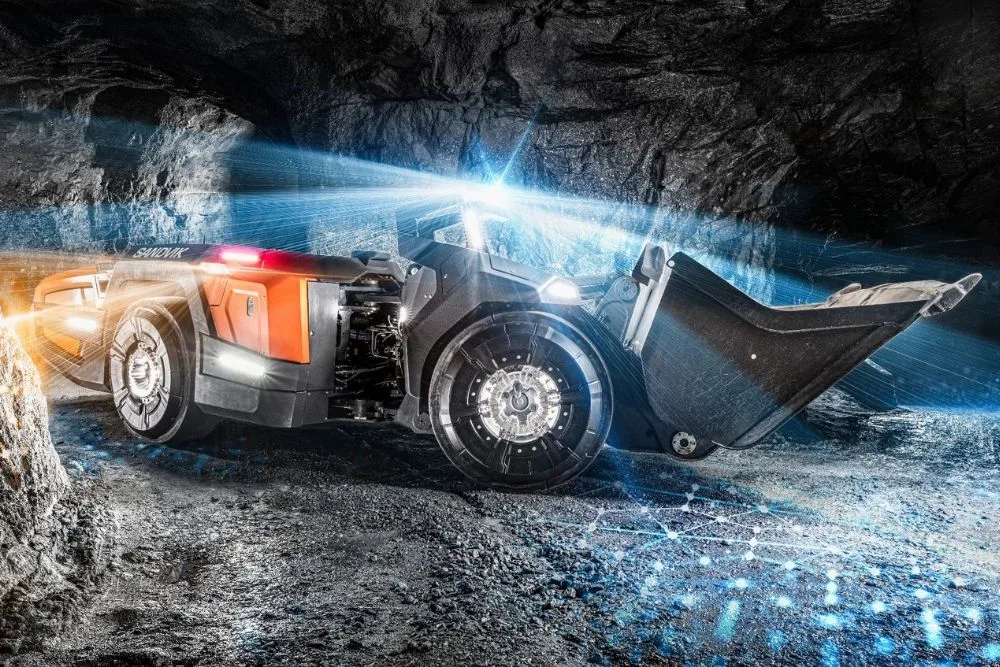
Electrifying mining equipment requires the ability to model and assess how new machinery performs in different operating environments. Sandvik’s Mining and Rock Solutions business area therefore wanted to develop an analysis tool that could clearly demonstrate the capacity of different machines and their battery packs to customers.
Battery capacity modeling led to a tool for analyzing overall productivity
Conventionally, static calculations have been made in Excel spreadsheets, but understanding the different real-life scenarios is often very challenging when going by the graphs alone. Therefore, Sandvik set out to create a dynamic calculation tool that would present an animation of the performance in the mining area being analyzed. The core of the simulation had been developed previously, but Insta was tasked with taking the source code and building an easy-to-use interface.
– The tool presents a map of the mine and the machinery that moves there in a realistic manner. The animation shows the practical results of different plans, whether they are applied to new or old mines, explains Sandvik’s Research Engineer Jenni Rekola.
Originally, the tool was intended to model only electric loading machinery and dumpers, as well as their battery life. However, the tool was eventually expanded to simulate diesel-powered machinery, from drilling equipment to pickup trucks. The system also considers the mine’s traffic rules.
– The incorporation of traffic rules has been groundbreaking, and Insta has done an excellent job with it. If you only work in a spreadsheet, it appears as if productivity grows the higher the more you add new machines. In reality, however, once the number of machines exceeds a certain limit, traffic jams will prevent productivity from growing any higher. The tool helps identify bottlenecks so that alternative solutions can be designed. Therefore, it can be applied in the planning of the mine’s layout as well as the development of overall productivity, Ms. Rekola says.
Making life easier for the sales, product development, and customers
Even though the tool has expanded and become more complex since the original plans, the development has gone smoothly.
– Whenever we have introduced more complex elements, we have been able to incorporate them in the old foundation. It has not been necessary to rebuild parts from scratch, and everything has fit in nicely with the original logic, Ms. Rekola says.
New features are being added all the time but, even with the current version, Sandvik has received a tool that has not been seen before. It supports the decision-making of Sandvik’s customers and assists the sales personnel by making productivity, electricity consumption, and resource calculations easy. In addition, the tool supports the collaboration between sales and product development, as it provides a shared way of describing the customers’ needs.
– There is no going back to having a million different spreadsheets, each dedicated to just one specific aspect. Now, the salespeople, customers, and product development can consistently get all of the relevant information from a single location.
The Design Sprint jump started the project and laid a strong foundation for the collaboration
The outset of the project was clear, but there was still some ambiguity with the expectations for the end result. Insta’s solution was to kick off the project with a Design Sprint event that allows creating a specification for the project quickly and in sufficient detail – this time, it only took four days.
The Sprint involved people from various areas around Sandvik. According to Jenni Rekola, this is specifically the reason why the new tool received a positive welcome and it fit in naturally in the everyday work of the sales personnel. It is easy to commit to choices that were made together.
– The importance of the Design Sprint in terms of project success cannot be overemphasized. Instead of several months, we were able to specify everything that we wanted in a really short period of time. In addition, the needs that were specified during the Sprint were implemented, and so the specification was perfect, Ms. Rekola adds.
The core teams from Sandvik and Insta got on the same wavelength during the Design Sprint, which was really beneficial for the actual programming effort. Ms. Rekola believes that this led to the successful collaboration between the companies.
– What I really value is that Insta’s people have the courage to challenge ideas. If I ask for something that does not serve the tool’s key goals – simplicity combined with sufficient precision – Insta’s team will not hesitate to question the suggestion or propose an alternative solution.
– Conventional software applications may have lots of unnecessary functions and nothing works exactly the way you want. Insta, on the other hand, has worked hard on usability, and the new system really wows its users. We have created a tool that even Sandvik’s customers would like to buy for their own use, Jenni Rekola says with a smile.

Tom Hannelius
Director, Business Development at Insta Advance, Software Consulting firstname.lastname (at) insta.fi