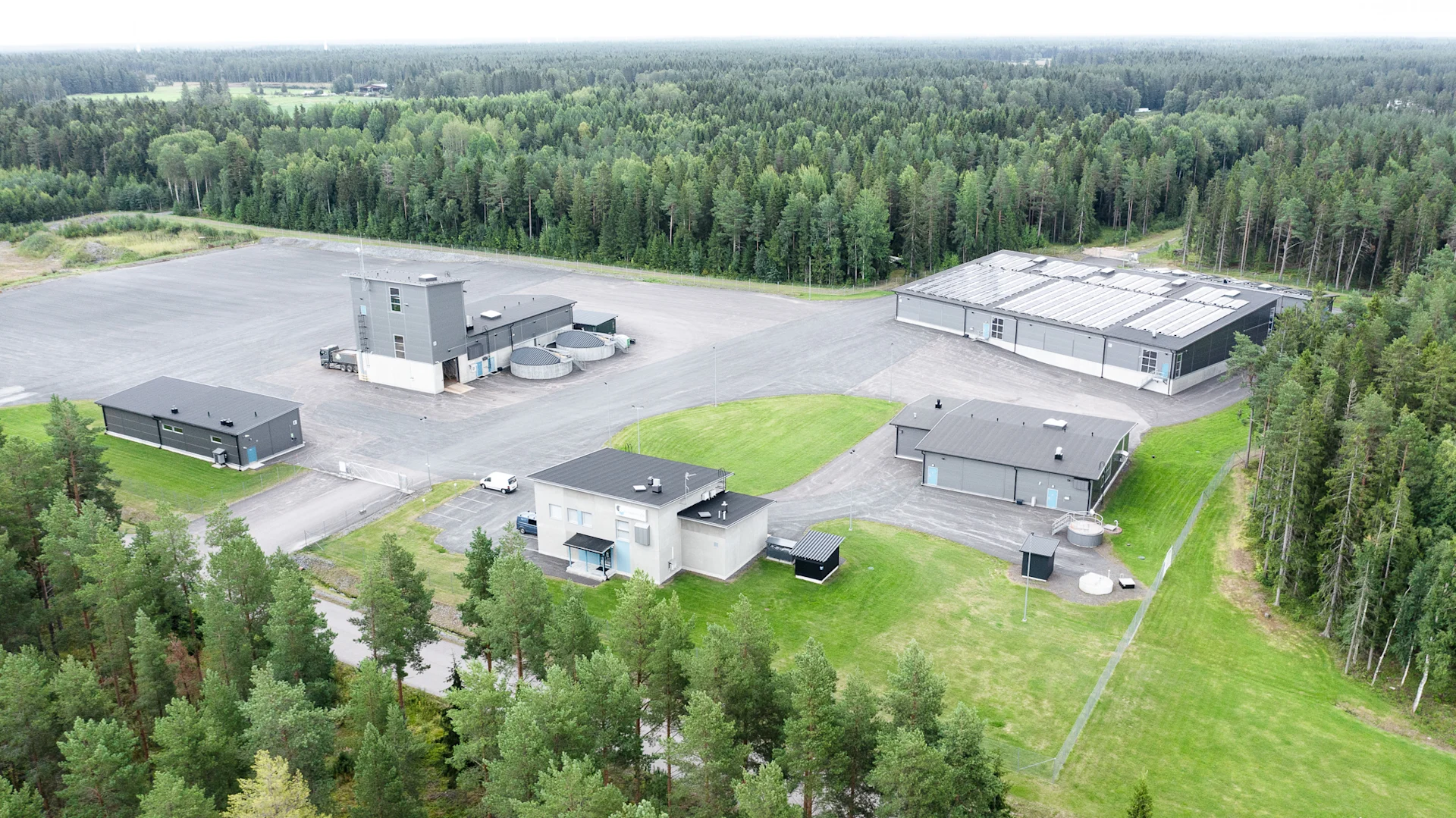
The Kalajoki Central Wastewater Treatment Plant, owned by Vesikolmio, treats wastewater conveyed through the sewer network of the Kalajoki region. The plant serves a population equivalent of approximately 42,000. The facility has previously invested in the development of automation and remote monitoring in cooperation with Insta. The latest project, involving AI-based process control developed in collaboration between Insta, Vesikolmio and Suomen SähköFlotaatio, resulted in significant reductions in both energy and chemical consumption.
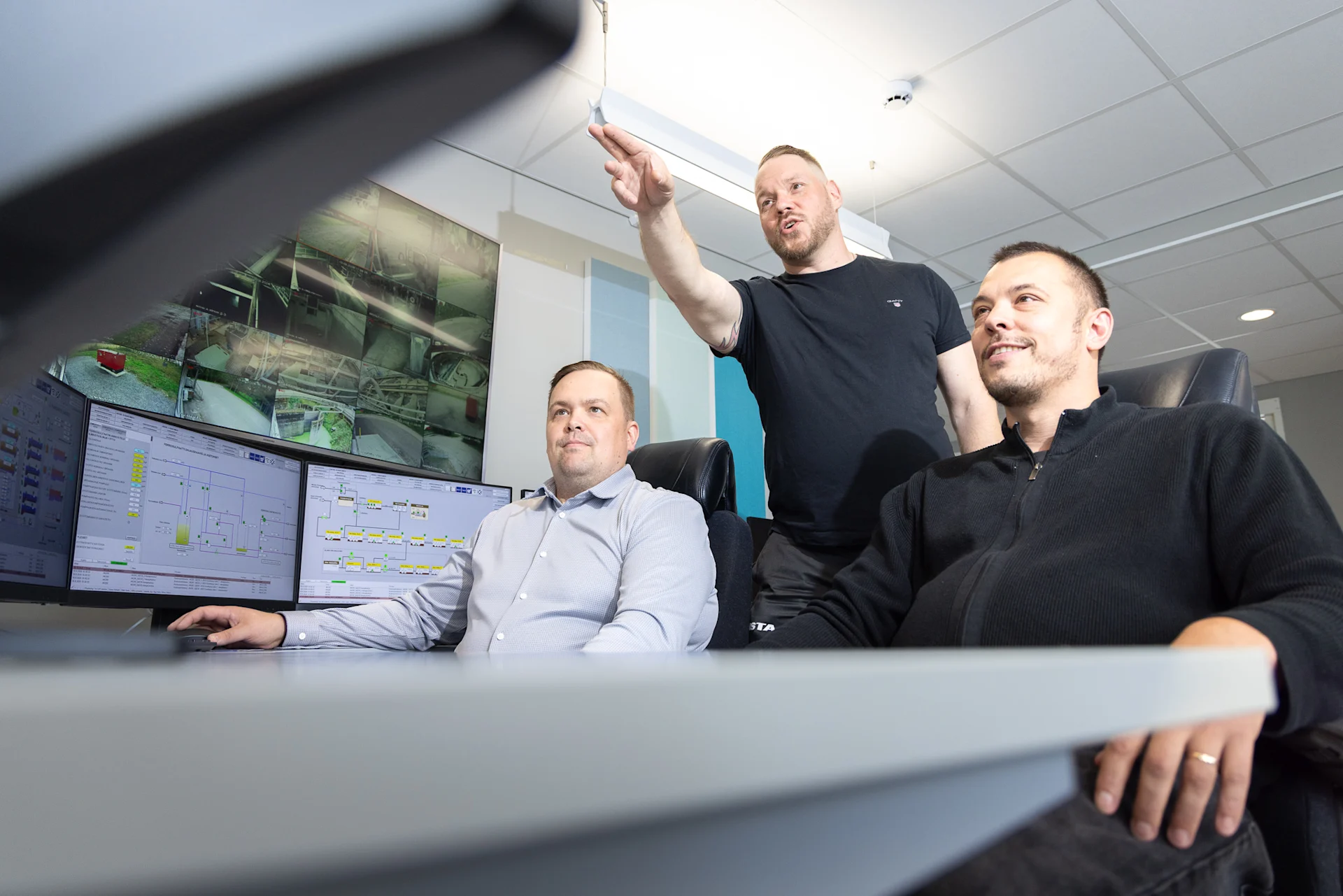
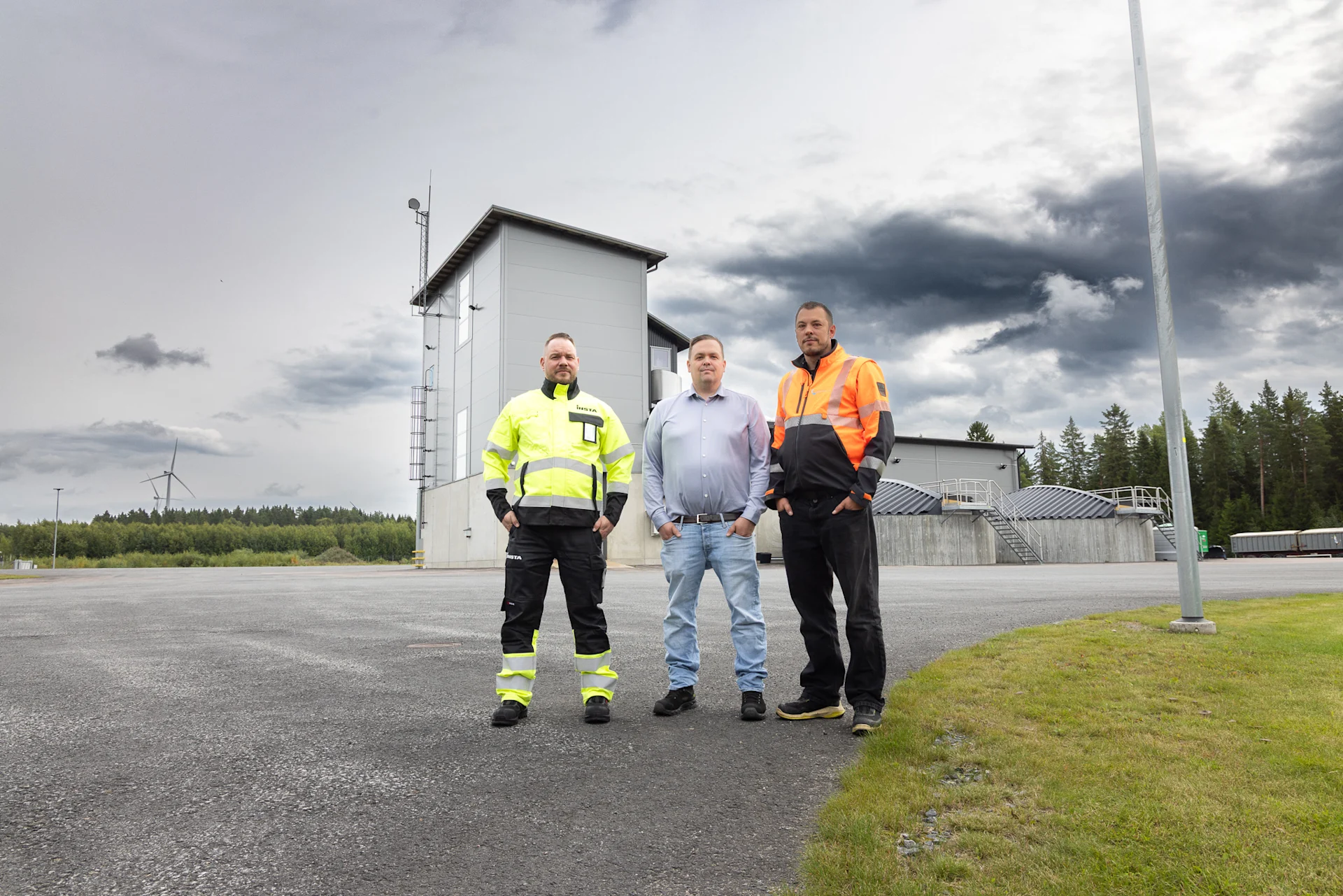
The AI-based higher-level process control solution utilizes real-time process data to support optimization and improve energy efficiency. Pictured from left to right are Perttu Pihlaja (Suomen SähköFlotaatio Oy), Vesa Nieminen (Insta), and Petri Lamminaho (Vesikolmio Oy).
The results positively surprised the customer
The impact of the AI-based control system is particularly evident in the consumption of aeration electricity and chemicals at the Kalajoki Central Wastewater Treatment Plant. Aeration electricity consumption decreased by 41.2 percent, while chemical consumption decreased by 66.3 percent. As less energy and fewer chemicals are required, the process operates more resource-efficiently and more stably. At the same time, the solution supports compliance with environmental permit requirements while reducing energy and chemical usage.
“Our goal was to make the treatment plant as energy-efficient as possible while improving process controllability. What positively surprised us, however, was just how well our objectives were achieved once the AI-based control system was introduced,” says Risto Bergbacka, Managing Director of Vesikolmio Oy.
“Utilizing AI in process control has proven to be a sensible approach. It enables significant financial savings while allowing the process to be controlled with greater precision than before,” adds Petri Lamminaho, Supervisor at the Kalajoki Central Wastewater Treatment Plant.
Programming expertise and process expertise worked hand in hand
Insta was responsible for the logic programming of the AI-based higher-level process control system and for implementing the control principles in practical automation. The treatment plant is a critical facility from the perspective of security of supply.
“It was extremely important to us that Insta was able to implement the control system locally within the plant’s own automation environment,” Bergbacka explains.
“The success of this project came from all the pieces falling into place. Vesikolmio knows its facility, Suomen SähköFlotaatio brought exceptionally strong process expertise, and our role was to implement the desired control system in practical automation,” says Vesa Nieminen, Service Engineer at Insta, who was responsible for the programming.
Perttu Pihlaja of Suomen SähköFlotaatio Oy, who was responsible for process development and the design of the AI controls, agrees.
“This would not have been possible without excellent automation and coding expertise. Insta succeeded in making demanding control principles work in real-world automation, and that played a major role in the success of the project,” says Pihlaja.
The AI-based higher-level process control solution at the Kalajoki Central Wastewater Treatment Plant was developed through collaboration between Vesikolmio, Insta and Suomen SähköFlotaatio.
Reliable Data and AI-Driven Predictive Capability Are the Keys to Strong Results
Traditional automation typically reacts to what is happening in the process at that very moment. However, the biological process of a wastewater treatment plant does not usually change immediately. Loading, flow rate, temperature, nutrient balance and sludge behaviour all influence one another, and the effects of changes become visible only after a delay.
“A human can control the process, but not with the same frequency and precision as an AI-based control system. This new system is capable of monitoring multiple variables in real time and continuously making adjustments according to the needs of the process,” Lamminaho explains.
A significant amount of work was carried out before AI-based control could be introduced. The implementation progressed in stages. First, the basic process controls were improved, the reliability of sensor data was verified, and control parameters were refined on the basis of new measurement data.
“We first had to ensure that the basic controls functioned as intended. Only after that did it make sense to build intelligence on top of them,” Pihlaja explains.
Today, the AI-based higher-level control system operates as a predictive and optimizing control layer on top of the plant’s automation system. It utilizes real-time measurement data, historical information and the current state of the process to anticipate how the process is likely to develop. It does not replace either the plant’s automation system or the expertise of operating personnel. If the forecast is not usable, the sensor data cannot be trusted, or an exceptional situation requires it, the process can be returned to a simpler control mode or manual operation.
Collaboration and its results have delighted everyone involved in the project
According to Bergbacka, the initiative for the AI project came from Vesikolmio’s own personnel.
“Our staff has traditionally been open to development and new ideas. When people are given the opportunity to influence their own work and development initiatives, both their sense of responsibility and the meaningfulness of their work increase,” Bergbacka says.
According to Bergbacka, the introduction of AI-based control changed everyday operations at the treatment plant. The workload of the operating personnel did not decrease. Instead, the focus shifted increasingly toward instrument maintenance, sampling, calibration and ensuring reliable process performance.
The Kalajoki Central Wastewater Treatment Plant project demonstrates that AI-based control is not merely a software layer that can simply be added to a process. It is a development effort in which plant operations, measurement data, process logic and automation are brought together and aligned.
“Insta has been a long-term and reliable process and automation partner for us. In this project, what stood out in particular was Insta’s open-minded and development-oriented attitude toward a new idea, and its willingness to move the solution forward in practice together with us and Perttu Pihlaja. We have been very satisfied with both the collaboration and the results. We also encourage other water utilities to embark on this kind of development work, as the results are rewarding once the solution is in operation,” says Bergbacka.
Owned by Vesikolmio Oy, the Kalajoki Central Wastewater Treatment Plant treats wastewater from the Kalajoki region. The facility has improved energy efficiency and process performance through initiatives such as an AI-based higher-level process control solution.
Next step: Applying AI to transfer pumping control
The results achieved at the Kalajoki Central Wastewater Treatment Plant have reinforced Vesikolmio’s view that AI should be utilized in the optimization of water utility processes. The company’s next step is to invest in applying AI to the control of transfer pumping operations.
This upcoming development project demonstrates that AI-based control will not remain a one-off experiment. Instead, it is becoming an integral part of Vesikolmio’s long-term development of water utility operations.
Looking to improve process control through data and automation?
Insta helps industrial companies and water utilities develop automation, process control and data utilization through practical, hands-on solutions. Explore Insta’s automation and electrification solutions and contact our specialists.